
I’ll start with a confession: I’ve never been a big reader. Growing up, I dreaded the books assigned in school and always preferred to watch the movie version or find some adaptation I could listen to instead. It wasn’t because I grew up surrounded by technology… far from it. I wasn’t an “iPad kid.” But even without screens as a constant distraction, I struggled to sit still and focus. I was (and still am) a speed reader, the kind who skims quickly but often has to stop and ask, wait, what did I just read? Then I’d go back, sometimes two or three times, just to grasp the page I had rushed through.
That said, I’ve always been more engaged when reading something I’m actually interested in. Fiction, adventure, and thrillers could hold my attention. I loved the idea of going into a bookstore, picking out a book, and picturing myself lost in it. But as a teenager and young adult, that excitement rarely translated into actually finishing the books I bought.
Why Reading Feels Harder Than Ever
This week’s reading from Johann Hari’s Stolen Focus echoed a lot of my personal experiences. Hari shared a striking statistic: between 2004 and 2017, reading for pleasure fell by 40% among men and 29% among women. That drop didn’t happen in isolation; it paralleled the rise of social media and other digital forms of entertainment that compete for our attention. Books are no longer the only way to immerse yourself in another world or learn something new.
Going deeper into the disruption of mind-wandering, Hari explains how our brains are constantly pulled toward stimulation. Like Hari, I rarely do anything in silence. I fill the background with music, podcasts, or TV, even when working on assignments. On walks, I feel almost forced to listen to something, or else the time feels slow and heavy. Yet silence and mind-wandering, as Hari points out, are not wasted moments; they’re when our brains connect ideas, reflect, and come up with creative solutions. This made me realize I probably need more of those empty, quiet stretches, even if they feel uncomfortable at first.
Have We Actually Forgotten How To Read?
The article, I Have Forgotten How to Read, by Michael Harris describes this problem on a larger scale. Harris admits he can no longer sink into a book like he once did. Online reading has rewired his brain to scavenge for quick facts and shareable content rather than patiently absorb long-form narratives. His struggle reminded me of my own tendency to skim and then realize I retained nothing. As Harris puts it, the issue isn’t whether we’re reading, but how we’re reading.
Another article, How to Remember What You Read, offered practical strategies that resonated with me. It emphasizes that passive reading leads to quick forgetting, while active reading (taking notes, reflecting, and making associations) creates lasting understanding. One suggestion stuck with me: don’t feel pressured to finish a book just because you started it. That shift in mindset might help reduce the anxiety I’ve always felt about reading “fast enough” or “finishing on time.”
Attention Spans, Memory Gaps
I’ve also noticed that I’m not great at recalling details from books, movies, or shows. My brother can quote lines word for word, while I barely remember the basics. Maybe that’s because I rarely give my full attention, or maybe it’s just how my brain works. As my boyfriend jokes, “I only hold onto information that matters… the rest is just clutter and goes as soon as it comes.” Reading strategies like building “mental models,” as mentioned in the article, might help me actually retain more of what I read.
And Then Came #BookTok
Here’s the twist in my story: I did eventually find my way back to reading and it wasn’t because of school or self-discipline. It was because of TikTok.
During the pandemic, #BookTok exploded, and suddenly, reading was cool again. Colleen Hoover’s It Ends With Us became a viral sensation, drawing in readers who hadn’t touched a novel in years. According to a piece in The Sydney Morning Herald, TikTok created “a Gen Z reading revolution” that revived the physical book market and brought bookstores back into focus. My friends and I were part of it. We’d buy books, swap them around, and trade recommendations. None of these books were “academic,” but who cares? They got us off our phones and into stories we couldn’t put down.
One article I stumbled across, written by another student in my master’s program, put it perfectly: TikTok shifted cultural habits “from dance moves to best-sellers,” showing how a digital platform could spark an old-school love for physical books. Another piece in The Week noted that Gen Z has carried this trend into real life with book clubs, social reading, and massive personal libraries proudly displayed online. What was once private and nerdy suddenly became communal and shareable.
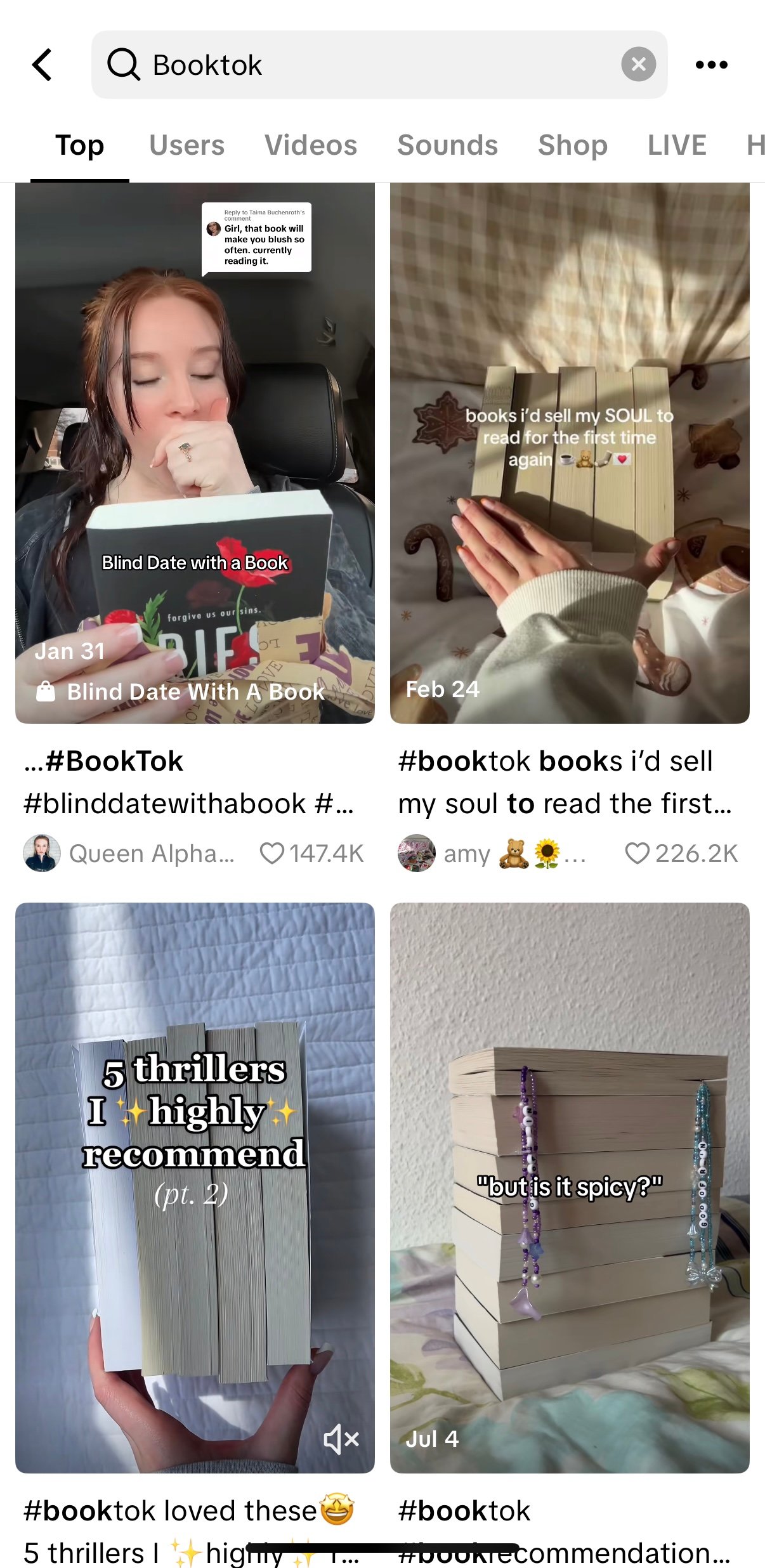
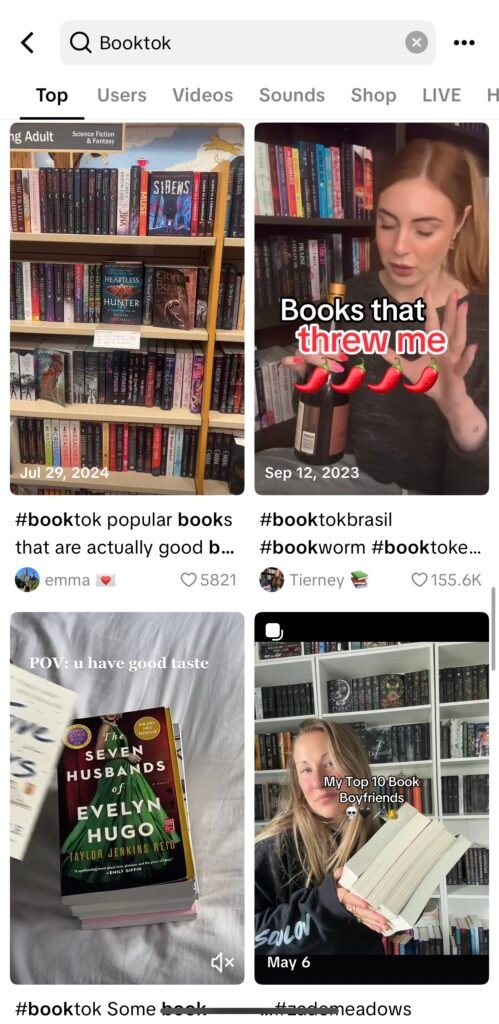
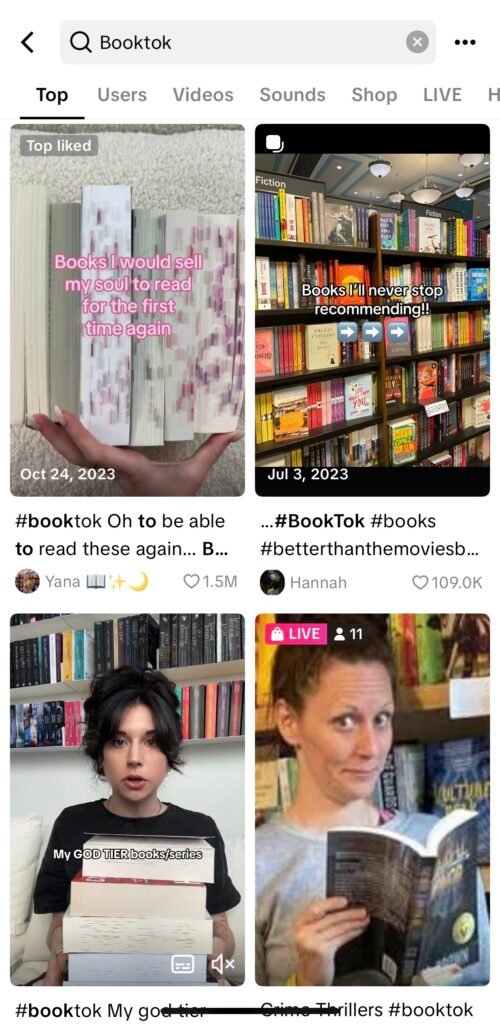
Below is an example of what would come up if you were to search “Booktok” on Tiktok:
Balancing Screens, Silence, and Stories
In many ways, my experience reflects the tension Hari and others describe. Our attention spans are under constant assault, making deep reading harder than ever. But at the same time, movements like #BookTok prove that the love of reading isn’t dead, it’s just evolving. For me, the challenge will be balancing the constant need for stimulation with the patience to sit, focus, and let my mind wander the way a good book allows.
References
Hari, Johann. Stolen Focus: Why You Can’t Pay Attention–and How to Think Deeply Again. Crown, 2022.
Harris, Michael. “I Have Forgotten How to Read.” The Globe and Mail, The Globe and Mail, 9 Feb. 2018, www.theglobeandmail.com/opinion/i-have-forgotten-how-toread/article37921379/.
Shane. “How to Remember What You Read.” Farnam Street, 14 Apr. 2020, fs.blog/how-to-remember-what-you-read/.
Joel Mathis, The Week US. “Gen Z Is Bringing Back Reading.” The Week, 14 Feb. 2024, theweek.com/culture-life/books/gen-z-reading-book-club-booktok.
Lapointe, Juliette. “From Dance Moves to Best Sellers: How Tiktok Has Influenced Gen Z’s ‘Must Reads.’” Medium, 10 Mar. 2024, medium.com/spring-2024-icm-506-writing-for-interactive-media/from-dance-moves-to-best-sellers-how-tiktok-has-influenced-gen-zs-must-reads-aa726859341a.
Novak, Genevieve. “How TikTok Created A Gen Z Reading Revolution.” The Sydney Morning Herald, 5 July 2023, www.smh.com.au/culture/books/how-tiktok-created-a-gen-z-reading-revolution-20230703-p5dlda.html.
One response
Your blog is a treasure trove of valuable insights and thought-provoking commentary. Your dedication to your craft is evident in every word you write. Keep up the fantastic work!